What is DMCA ignored hosting refers to a hosting model where providers do not automatically act on takedown notices issued under the Digital Millennium Copyright Act (DMCA). The DMCA is a United States copyright law, specifically Section 512, which defines a “notice-and-takedown” system. Under this system, service providers must remove allegedly infringing content upon receiving a valid complaint to maintain safe harbor protection.
The “ignored” part does not imply that laws are disregarded. It reflects jurisdiction. If a server is located outside the United States, the DMCA has no direct legal authority. Providers in such locations are not obligated to enforce U.S. copyright claims unless local law or a court order requires it.
Jurisdiction determines enforceability. A hosting provider in Eastern Europe operates under national law, not U.S. statutes. For a takedown to be enforced, the complainant must follow the legal process of that country, which often involves court filings rather than automated notices. This additional legal barrier changes how complaints are handled and how quickly content is removed.
How Does DMCA Ignored Hosting Work?
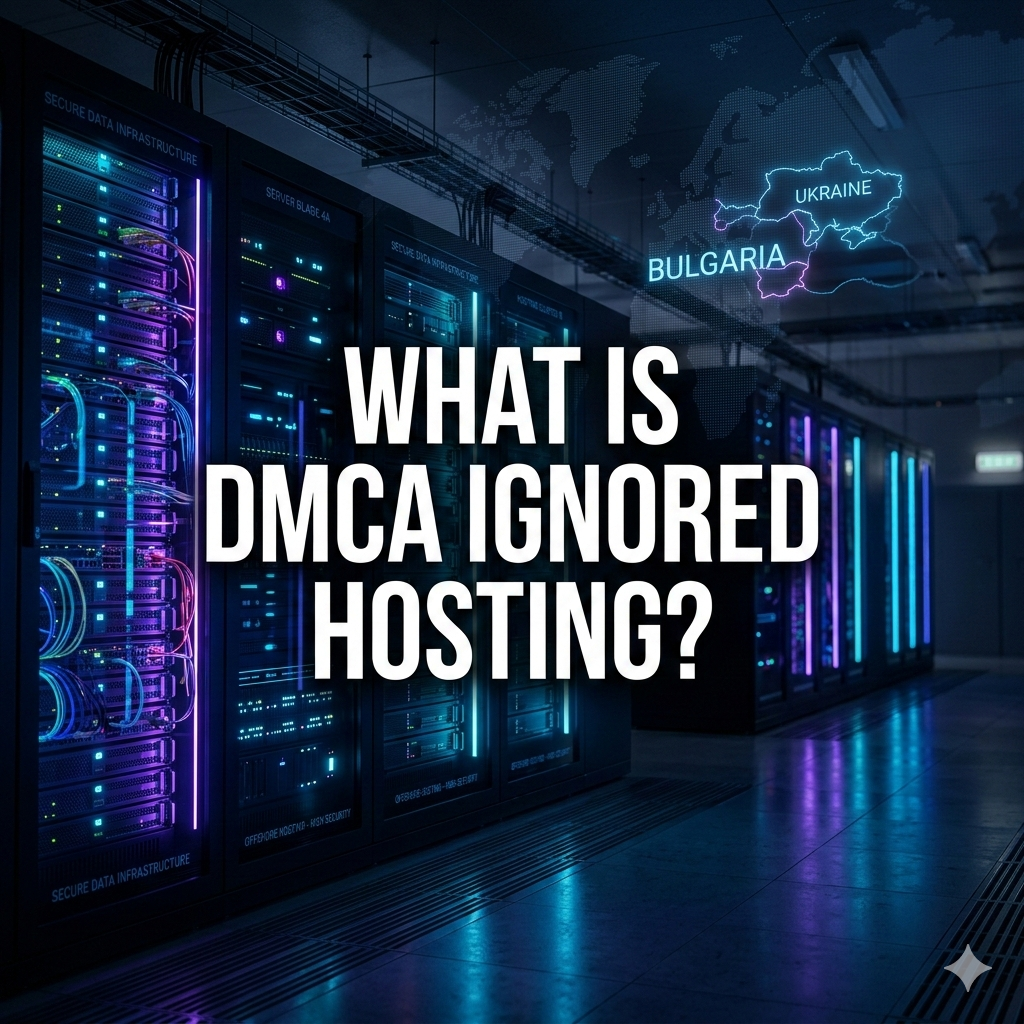
DMCA ignored hosting relies on physical server placement in jurisdictions where foreign copyright claims are not automatically recognized. Common locations include Bulgaria and Ukraine, where providers follow domestic legal procedures rather than external notice systems.
When content is hosted on infrastructure in these regions, a typical DMCA notice sent by a U.S.-based rights holder has no direct effect. The provider evaluates complaints based on:
- Local copyright law
- Terms defined in the Acceptable Use Policy (AUP)
- Whether a valid court order exists
Unilateral enforcement is not possible. A rights holder cannot compel a provider in another jurisdiction to remove content without engaging the local legal system. This usually requires:
- Filing a complaint in the host country
- Obtaining a court order
- Serving that order to the hosting provider
Only after these steps does enforcement become mandatory.
From a technical standpoint, dmca ignored hosting environments are often built on dedicated or bare-metal servers rather than heavily shared infrastructure. This allows providers to maintain tighter control over abuse handling and network policies. Some also deploy custom routing and upstream arrangements to reduce dependency on providers that might enforce stricter policies.
However, network-level pressure can still occur. Transit providers or upstream carriers may act independently if traffic patterns or complaints affect their operations. For this reason, stable dmca ignore hosting setups depend on both legal positioning and network design.
Who Needs DMCA Ignored Hosting?
DMCA ignored hosting is used in scenarios where content legality varies across jurisdictions or where automated takedown systems create operational disruption.
Content Publishers with Contested Claims
Publishers dealing with disputed ownership or licensing often use dmca ignored hosting to avoid repeated takedown cycles. This includes platforms distributing media under unclear or region-specific rights agreements.
Journalists and Whistleblowers
Investigative platforms and whistleblower sites may host sensitive material that attracts legal pressure. In some cases, takedown requests are used strategically rather than purely for copyright enforcement. Hosting outside DMCA jurisdiction provides procedural protection.
Globally Operating Businesses
Companies distributing content across multiple regions encounter conflicting legal frameworks. A piece of content may be lawful in one country and disputed in another. DMCA ignored hosting allows these businesses to anchor their infrastructure in a single jurisdiction and handle disputes through formal legal channels.
File Storage and Media Platforms
File hosting services, streaming platforms, and archival sites frequently receive large volumes of automated complaints. Without dmca ignore hosting, operational stability becomes difficult due to constant content removal and reinstatement cycles.
News Archives and Historical Repositories
Archival platforms preserving historical documents, media, or leaked material may face retroactive copyright claims. Hosting in a jurisdiction that requires court orders for enforcement provides continuity.
Use of no dmca hosting does not eliminate legal risk. It shifts the enforcement process from automated notice systems to formal legal procedures.
DMCA Ignored Hosting vs Bulletproof Hosting — Key Difference
The distinction between dmca ignored hosting and bulletproof hosting is often misunderstood.
DMCA ignored hosting operates within the legal framework of the country where the servers are located. Providers may refuse to act on foreign copyright notices, but they comply with local law and valid court orders. Abuse policies are still enforced, particularly for activities that threaten network stability or violate criminal law.
Bulletproof hosting is typically described as infrastructure that ignores all forms of complaints, including those from law enforcement. This model is unstable and often short-lived due to upstream pressure, blacklisting, and legal action. It is not a sustainable or legally grounded approach.
A provider operating in Bulgaria or Ukraine follows national regulations. Copyright enforcement exists in both countries, but it requires due process. That is the core difference: dmca ignored hosting filters complaints through jurisdiction, while bulletproof hosting attempts to bypass enforcement entirely.
What Can and Cannot Be Hosted?
Allowed content depends on the provider’s AUP and the laws of the hosting country. There is no universal rule set, but patterns are consistent across most dmca ignored hosting environments.
Typically Acceptable
- Content with disputed or region-specific copyright status
- File sharing platforms and storage services
- Streaming platforms operating across multiple jurisdictions
- Privacy-focused publications
- User-generated content platforms
These use cases benefit from reduced exposure to automated takedown systems.
Typically Not Acceptable
- Content illegal under local law
- Child exploitation material
- Malware, botnets, and exploit distribution
- Phishing and identity theft infrastructure
- Direct financial fraud operations
Providers enforce these restrictions to maintain compliance and avoid network-level penalties such as IP blacklisting or upstream termination.
Most no dmca hosting providers publish an AUP outlining prohibited activities and enforcement procedures. That document defines the actual boundaries of what can be hosted, not marketing terminology.

Top DMCA Ignored Hosting Locations in Europe
Location determines both legal exposure and infrastructure quality. Several European jurisdictions are commonly used for dmca ignored hosting.
Bulgaria
Bulgaria is an EU member state with its own judicial system. Copyright enforcement exists but requires formal legal action. Courts operate independently, and foreign notices do not trigger automatic compliance.
Advantages include:
- Established data center infrastructure
- EU connectivity and network quality
- Clear legal procedures
Ukraine
Ukraine operates outside the EU framework and maintains its own legal system. Foreign copyright claims require local processing, which introduces delays and procedural barriers.
Advantages include:
- Flexible enforcement environment
- Competitive pricing
- Sovereign jurisdiction independent of EU directives
Limitations include geopolitical and infrastructure considerations.
Netherlands (Common Misconception)
The Netherlands is often marketed as a dmca ignored hosting location, but this is misleading. Dutch law enforces copyright protections, and providers respond to complaints under national regulations.
While enforcement is more structured than in the U.S., it is not absent. Hosting in the Netherlands does not equate to ignoring copyright claims. Providers there follow Dutch law, which can still result in content removal.
How to Choose a DMCA Ignored Host
Selecting a provider requires evaluating both legal positioning and technical capability.
Physical Server Location
The actual server location matters more than the company’s registration address. A provider registered in one country may operate hardware in another. Jurisdiction applies to the server location.
Response Policy Documentation
Clear documentation of how complaints are handled is critical. Look for:
- Defined abuse handling procedures
- Distinction between DMCA notices and court orders
- Response timelines
Ambiguity indicates operational risk.
DDoS Protection
Services hosting controversial or high-traffic content are frequent DDoS targets. Adequate mitigation capacity is required to maintain uptime.
Payment Options
Many dmca ignore hosting providers accept cryptocurrencies or alternative payment methods. This reflects the nature of their client base rather than a technical requirement.
Uptime and SLA
Reliable providers define uptime guarantees and hardware replacement timelines. Bare-metal environments should include clear service level agreements.
Network Quality
Evaluate upstream providers, routing efficiency, and bandwidth capacity. Poor network design leads to instability regardless of legal positioning.
Frequently Asked Questions
Is DMCA ignored hosting legal?
Yes. It is legal when the provider operates within the laws of the country where the servers are located. The DMCA does not apply outside the United States, but local copyright laws still exist and can be enforced through courts.
Will my content never be taken down?
No. Content can be removed if it violates local law or if a valid court order is issued. DMCA notices alone are usually insufficient, but legal enforcement remains possible.
What is the difference between offshore and DMCA ignored hosting?
Is no DMCA hosting completely unrestricted?
Offshore hosting refers to infrastructure located outside a user’s home country. DMCA ignored hosting is a subset where providers do not automatically enforce U.S. copyright notices. Not all offshore hosting ignores DMCA complaints.
No. No dmca hosting means DMCA notices are not automatically enforced. Providers still maintain AUP policies and must comply with local laws. Illegal activity under the host country’s jurisdiction is not permitted.